



 15 / 40

15
MARKET UPDATE
In November 2015, Frank Dunne
(a partner at Watson, Farley and
Williams, who undertakes a broad
range of ship finance work and
commercial shipping transactions for
major international shipping finance
lenders and shipowners) summed up
his thoughts on the Dry Bulk sector;
“We appear to be at a ten-year low
in the value and freight rate cycle for
dry cargo. If so, now is a good time
to buy, so long as leverage is low and
the further investment in a carry cost
is available. Market sentiment is that
values and freight rates are unlikely
to improve significantly for the next
couple of years. The fleet is young
so it will take time for over-capacity
to be worked out. Much depends on
China and growth. Also restraint by
Shipyards to avoid adding capacity as
soon as conditions start to improve.”
OVER-SUPPLY
There is no denying that the Dry Bulk
shipping market has experienced very
tough times since the effects of the
world economic recession took hold
in the sector in late 2008. Pricing was
hit hard: as an example, one-year time
charter rates were at their highest for
the Supramax vessels in 2008, reaching
over $60,000/day and have since
struggled to recover, and in late 2015
were sitting at well below $10,000.
9
The Baltic Dry Bulk Index (BDI) hit an
all-time low in 2015, but, although
reduced, there is still trade growth
within the sector, with expected
total Dry Bulk trade growth in 2015
at 1.2%, compared to 8.4% in 2014
26
.
This indicates that there is increasing
demand to move commodities by sea,
albeit affected by demand-side issues,
and highlights the huge importance of
supply-side factors in terms of the Dry
Bulk fleet. It is these supply-side issues
which have had the greatest influence
on the market in recent years, with
the Financial Times commenting that,
“Most shipping sectors remain in deep
financial trouble. Delivery of the glut
of vessels ordered before the financial
crisis has driven down earnings for
dry bulk carriers, most tankers and
container ships.”
27
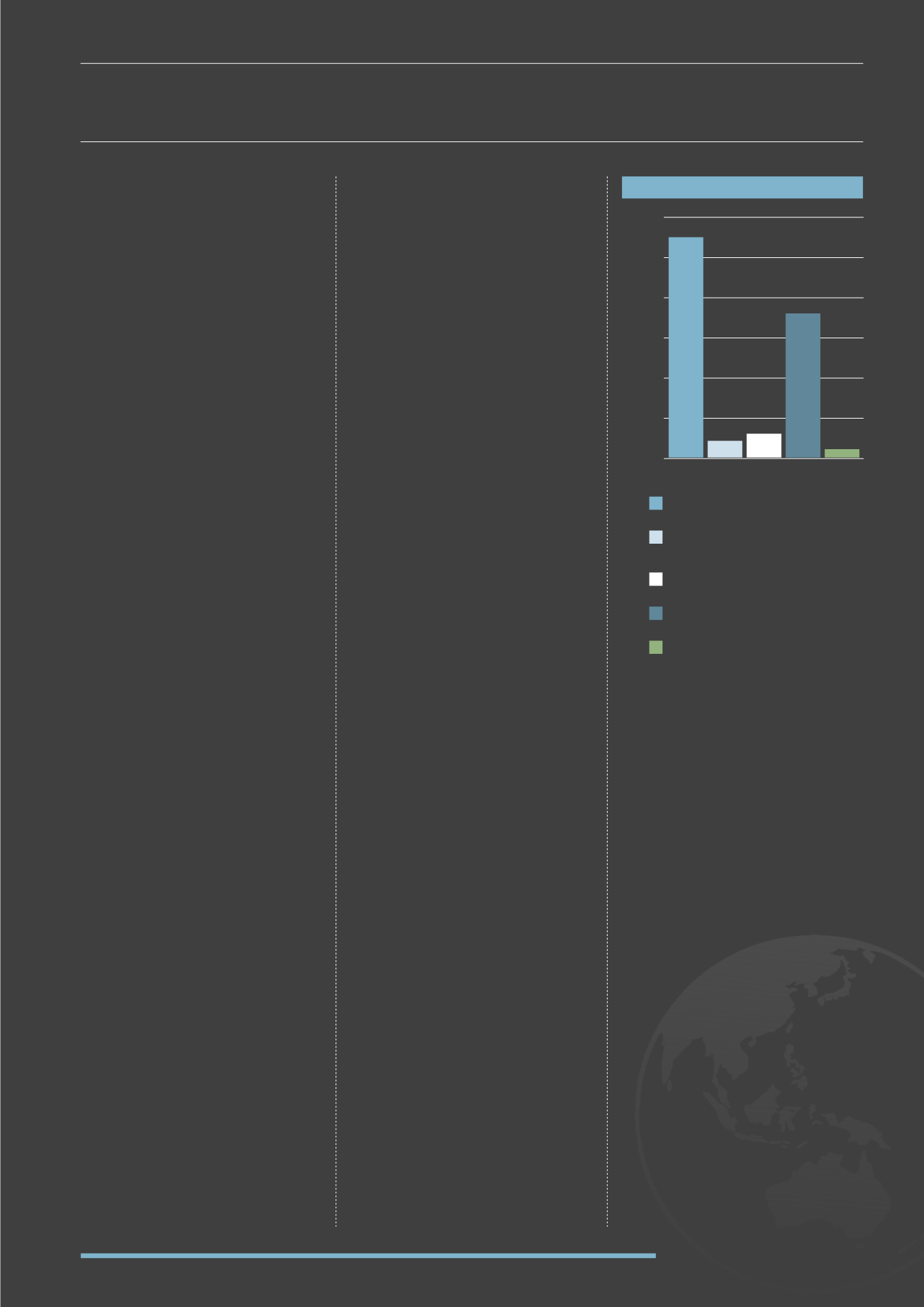
Owners, operators and analysts are
fully aware of the cycles experienced by
this sector and according to Platts Dry
Bulk Market Survey August 2015, ”55%
[of bulk market participants] indicated
tonnage oversupply as the main issue
for the dry bulk market.”
This recognition of the contribution
of vessel over-supply to the weak
market has led to action in the form
of a reduction in the number of new
ships ordered, coupled with high levels
of demolitions (scrapping of ships);
Bimco, the world’s largest international
shipping association was positive about
the trend for market improvement in
October 2015, citing the marginal year-
to-date growth of the dry bulk fleet of
just 2.1%, made up of the inflow of 39.7
million dwt offset by demolition of 23.8
million dwt. In terms of new orders,
Clarkson’s orderbook statistics showed
only 84 new contracts recorded at the
end of August 2015, in stark contrast to
less than two years ago when capacity
equal to the year-to-date amount in
2015 (4.7 million dwt) was contracted in
just 16 days.
28
In fact the delivery of previously
ordered new vessels, at a time when
the market outlook was stronger, is
part of the problem and a further 36.3
million dwt of Dry Bulk vessel capacity is
expected to hit the water by the end of
2015
29
. This is made up of 118 Capesizes,
139 Panamaxes, 300 Supramaxes (155
ships last year) and 217 Handymaxes.
However, delay, cancellation or default
on newbuild orders should also be
taken into account, with a number
considered doubtful for delivery;
Drewry expect 7% of Handymax orders
and 17% of Supramax orders to be
cancelled. Furthermore, a number of
Chinese shipyards are in trouble or have
filed for bankruptcy protection while
Korean yards are also burdened with
high debts.
When demolition is taken into account,
Bimco predicts that 2015 fleet growth
will be at a 10-year low of 2.5%
28
.
Dryships Inc. puts this figure at only
2.4% in 2015, followed by a 4.0%
increase in 2016
30
.
MAIN ISSUE FOR THEMARKET
60
50
40
30
20
10
0
“Most shipping sectors remain
in deep financial trouble.
Delivery of the glut of vessels
ordered before the financial
crisis has driven down earnings
for dry bulk carriers, most
tankers and container ships.”
Financial Times
Oversupply of tonnage
China & Europe push towards
greener energy
Low tonne-mile demand
All of these factors
Other
% of respondents
For the year to September 2015, Drewry
figures put fleet growth at around
3%, bearing in mind the overall fleet
size of 10,237 vessels of 747 mdwt in
September 2014, compared with the
September 2015 numbers. Previous
years’ increases have been much more
significant, with Intercargo putting the
2012 Dry Bulk fleet at 8,141.
Of course, these statistics mask
variances for different vessel types,
which in turn have an impact on
the market. For example, Panamax
and Supramax fleets are expected to
increase by 1% and 4% respectively
31
in
2015. Such variations are a mark of the
differing markets in which the various
Source: Platts