



 27 / 92

27
There are a number of different risks
advisers and investors should bear in
mind when considering VCTs.
INVESTMENT RISK
Smaller companies are generally
more risky than their mainstream
counterparts.
However, it can be argued that AIM
shares and that more established firms
or project-based opportunities are ways
to make qualifying investments that
may be less exposed to these risks than
earlier stage companies.
The research and statistics on smaller
company angel investing are revealing.
According to research by innovation
charity NESTA 56% of investments
return less than cost, 33% returned 1-5x
cost and 9% return 10x cost or greater.
This is an argument for diversification,
and for most people that may well mean
choosing to use a manager to provide
professional stock picking and portfolio
construction. To put it another way, if
you are looking for exposure to smaller
companies, then a professionally run
VCT with the associated tax reliefs is
probably one of the best ways to do
it. However, note that not all VCTs are
based around having a very diverse
portfolio. Some have a strategy of
concentrating on just a handful of firms
that they feel represent low risks and
reliable income. Of course this is also
a good strategy, but a pitfall to watch
out for here is the possibility that there
is not enough potential growth in the
portfolio to overcome a catastrophic
failure of one or two of the larger
investments.
Many VCTs also offer advice, mentoring,
access to their network and other
forms of non-financial support for their
investee companies: 76% of investee
companies have a representative of the
VCT manager on their board (AIC, Going
for Growth).
We need to be clear though - although
many VCTs are focused on these
kinds of small, early stage companies,
many others are not, and instead are
focused on providing expansion or
replacement capital to bigger, better
established firms. Conventional wisdom
suggests that these bigger firms are
still more risky than their listed, large
cap counterparts. Certainly they have
more difficulty raising capital. However,
consider that they are not exposed
to the volatility of the stock market -
good quality firms in this part of the
investment universe can represent
very good value, low risk opportunities,
particularly if the objective is income
rather than growth.
LIQUIDITY
One of the biggest issues that VCT
investors have had in the past is the
ability to exit the VCT itself. They are
certainly more liquid than their EIS and
SEIS counterparts as they are traded on
the main market, but the discount to
the NAV often makes this liquidity feel
a little worthless...We’ll look at some of
the ways managers try to address this
issue in the
Depth and Detail
section, but
for now we’ll focus on painting a broad
brush picture.
LIQUIDITY IN THE
UNDERLYING INVESTMENTS
Smaller companies are inherently less
liquid than bigger ones. Investments in
unquoted companies usually have to
be held for the long term until an exit
can be achieved, and any kind of exit
is likely to be a binary event - a trade
sale, management buyout or stock
market listing either happens or it
doesn’t. There can be big rewards when
these exits are achieved, but it takes
a lot of time and effort to make them
happen and if they fall through then the
situation reverts back to square one.
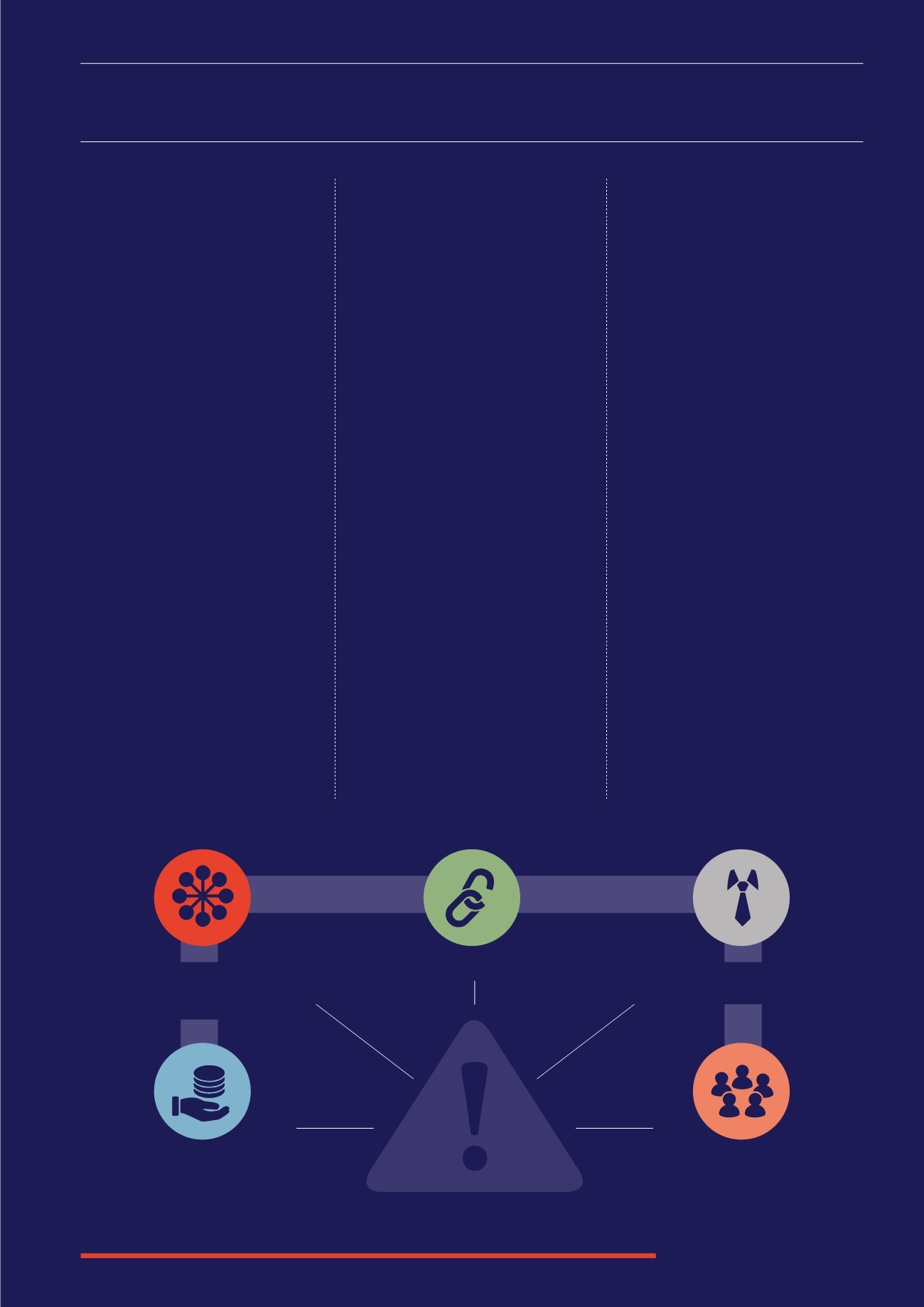
RISKS OF VCTs
RISKS OF
SMALLER
COMPANIES
WEAK/NEGATIVE
CASH FLOW
LESS FINANCIAL RESILIENCE
OVER RELIANCE ON
A FEW CUSTOMERS
UNPROVEN BUSINESS MODELS
IN EARLY STAGE COMPANIES
INEXPERIENCED MANAGEMENT