



 31 / 40

31
The typical owners
of Dry Bulk vessels
include public and
private shipping
companies,
investment funds,
ultra-high net
worth families and
family offices
.
The high capital-intensive nature of the
investment sector has generally meant
that investments are reserved for
institutional or large investors, with the
exception of publicly held corporations.
Nevertheless, more recently, the market
has opened up with new investment
money particularly attracted to the
distressed nature of many shipping
companies, loans and assets.
Additionally, traditional sources of
funding have become less enthusiastic
about lending to shipping, primarily
due to the increased capital adequacy
requirements of banks, coupled with
the high resourcing requirements and
cyclical nature of the industry
2
. Hedge
Fund Journal cites the stable medium-
term fundamentals, contractual
flexibility and the introduction of
innovative structures as the enticement.
CORPORATE INVESTMENT
Historically, shipping companies are
at the origins of investing in shipping
and there remain private companies in
the sector, for example Ceres Hellenic
Enterprises, which is a large traditional
Greek ship management company with
family shipping interests that date back
to 1824. Exposure to private shipping
entities is difficult and likely extremely
costly, although, interestingly, one of the
company’s divisions, DryLog Ltd., which
makes investments in other companies
involved in Dry Bulk shipping, as well
as directly owning some ships, did sell
some shares in an IPO in 2012.
HOW TO INVEST
Still, the more accessible investment
route is via listed shipping companies,
of which there is a substantial number,
listed on various international stock
exchanges, providing liquidity benefits
and the framework of regulations and
governance applied to share issuing
entities. These include Dry Ships Inc,
Star Bulk Carriers Corp, both listed on
the Nasdaq and Scorpio Bulkers, Navios
Maritime Partners, Navios Maritime
Holdings and Diana Shipping, listed on
the New York Stock Exchange.
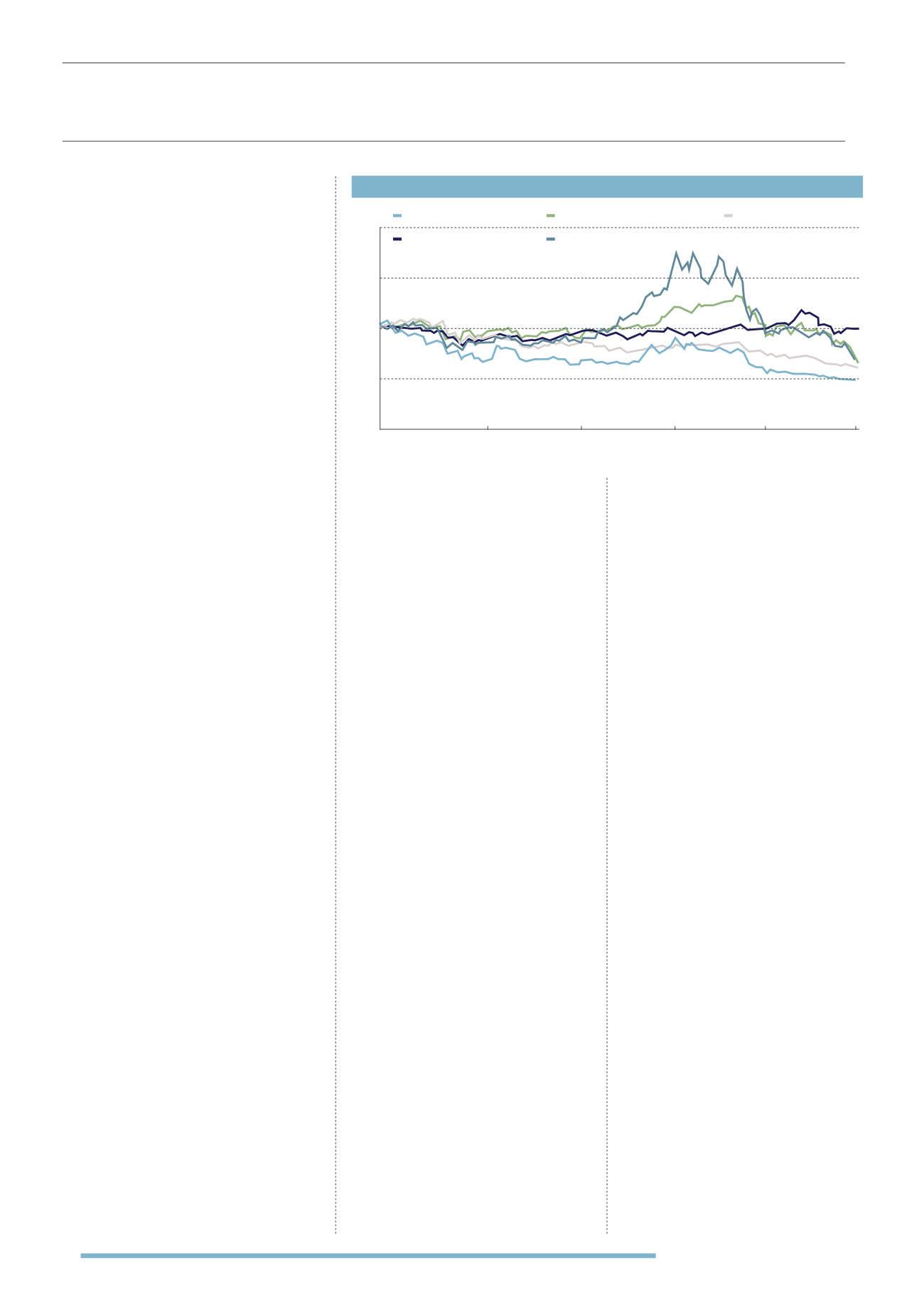
Performance figures over the last
five years show the highs and lows
associated with a cyclical sector
where volatility is a symptom of finely
balanced factors.
Buying and selling shares can provide
investors with a low fee method to
participate in potentially lucrative
markets, but if investors are very
active and make a number of trades
looking for short term gains, dealing
fees may become a problem. Also,
without advice, investing in a complex
investment sector in this way is not for
the risk averse or those who cannot
afford to lose their funds. In this arena,
investors are relying on the expertise
of the managers of their corporate
entities and the structure of those
entities, judging that they have the
capacity to withstand the devastating
market shocks which can occur. In
addition, the right entry and exit time
is of great importance if the investor
wishes to avoid the hard times, or even
to benefit from medium to long term
trends, whilst attempting to ride shorter
term fluctuations and this is likely to
require significant skill and market
understanding that anyone outside of
the industry is unlikely to possess.
FUNDS
It is possible to gain exposure to
various sectors of the shipping market
through a number of different fund
types including Exchange Traded Funds
(passive investments mirroring a market
or index and traded like individual listed
stocks
73
), such as the Guggenheim
Shipping EFT. However, currently, the
most notable players in terms of fund
investing into Dry Bulk shipping are
private equity and hedge funds.
PRIVATE EQUITY
Private equity is finance provided in
return for an equity stake in potentially
high growth companies; private equity
firms raise funds from institutional
investors such as pension funds,
insurance companies, endowments, and
high net worth individuals and use these
funds, along with borrowed money and
their own commercial acumen, to help
build and invest in companies that have
the potential for high growth
74
.
Private equity is suited to the Dry
Bulk shipping sector because it is
in a position to take advantage of
opportunities whenever they are
available as it can access funds at times
when they cannot be easily sourced
elsewhere. In this way, private equity
firms have invested in debt-distressed
businesses particularly affected by
downturns. By taking advantage of
DRY BULK SHIPPING PERFORMANCE
2011-2016
200%
100%
0%
-100%
-200%
2012
2014
2013
2015
2016
SPDR S&P Metals
and Mining (ETF)
Dry Ships Inc
Navios Maritime Partners LP
Navios Maritime Holdings
MSCI China Index Fund
Source: Marketrealist